
The Product Strategy and Product-led Blog
plg
PLG Is Part of Your GEO Strategy
GEO strategy — making your company visible to AI engines — comes down to one question: what does an AI treat as evidence that your product is credible?
Enrico Bruschini | July 7, 2026
GEO strategy — making your company visible to AI engines — comes down to one question: what does an AI treat as evidence that your product is credible?
The answer is not your website copy. A DerivateX study published in May 2026 tested 40 B2B SaaS categories across 233 ChatGPT recommendations. AI cited a vendor’s own website only 11.6% of the time. The other 88.4% went to third-party sources: community discussions, comparison posts, public documentation written to be useful rather than promotional.
PLG companies produce exactly that substrate. Not because they planned for AI search. They produce it because their go-to-market motion requires it.
What PLG forces you to build
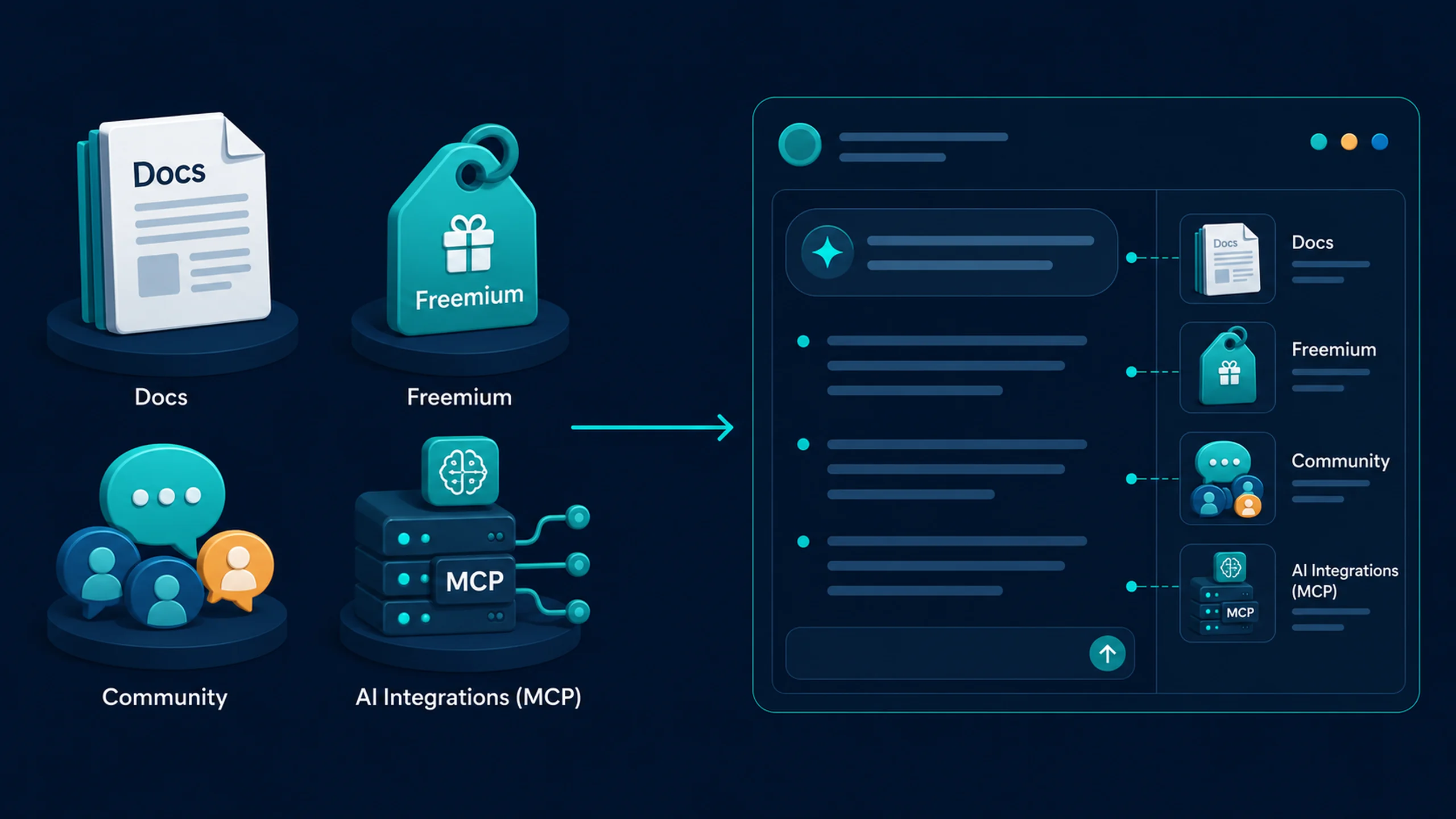
PLG works because users evaluate the product independently, before any sales conversation. That motion creates four structural outputs — and each one is a GEO signal.
Structured, public documentation. Self-serve users cannot call support for every question. PLG companies build documentation because the product cannot grow without it. Not marketing copy — specific, factual descriptions of what the product does, how it works, what integrations exist, and how to get started. That is also the format AI engines prefer when someone asks how a product works. A sales-led company has sales decks. Sales-led companies clearly have docs as well, but they often end up being not as polished as those of PLG companies. A vague answer in a competitive AI evaluation is a lost recommendation.
A real free tier. Not a “contact sales for a trial” form. An actual tier that a developer or evaluator can access without human intervention. The free tier creates real users; people who tried the product without being managed by a sales rep. Real users write about what they tried, recommend it to colleagues, discuss it in Slack communities, Reddit threads, and Stack Overflow answers. That referral and review motion generates independent third-party discourse across every surface AI engines crawl. Muck Rack’s longitudinal research across 25 million cited links (July 2025 to May 2026) found that 82–89% of AI citations come from earned media. A free tier is the engine that produces that earned media. Rampiq’s May 2026 analysis found that 85% of B2B AI citation queries were answered from third-party sources rather than company websites. Sales-led products with no self-serve entry point have no mechanism to generate that substrate.
Transparent pricing. PLG companies publish pricing because the self-serve funnel requires it — a user who hits a paywall without knowing the price churns. Transparent pricing means an AI engine can answer “how much does X cost?” with a fact. Sales-led companies that hide pricing behind “contact us” give AI nothing to cite.
AI integrations and ecosystem legibility. PLG companies build integrations throughout the product ecosystem, and increasingly that means AI-native integrations: MCP servers, Claude connectors, OpenAI plugins, Cursor integrations, GitHub Copilot extensions. These are not nice-to-haves. They are a signal that the product belongs in an AI-native stack. When I looked at the tools recommended for my marketplace project, every one had either an existing AI integration or a well-documented API that AI tools could reason about without a dedicated connector. Dash0, the tool I added through my own judgment rather than AI recommendation, had a clear API and structured documentation. That legibility was enough. The products that are undocumented at the API layer, with no integration footprint, are the ones AI cannot reason about thus cannot recommend.
Those four outputs were built for self-serve user acquisition. They now serve a second purpose. Enterprise buyers use AI to research vendors before the first sales conversation. The same assets PLG required are what AI engines use to assess credibility.
The developer tool evidence
I noticed this pattern when building a technology stack for a new project. I asked an AI for a stack recommendation. It came back with: Neon for the database, Typesense for search, Resend for transactional email, Railway for infrastructure, Sentry for observability.
In each case there was a stronger-incumbent alternative. The AI passed over it. The table below shows what was chosen, what was passed over, and what actually drove the decision.
| Category | Chosen | Passed over | What drove the AI recommendation |
| Database | Neon | Supabase PlanetScale | Neon has a real free tier, deep public documentation, and Git-like branch-per-PR, widely discussed in developer communities. PlanetScale removed its free tier; the community noticed and wrote about it extensively. Supabase has a free tier but bundles features that generate cluttered, harder-to-cite documentation. |
| Search | Typesense | Algolia Elasticsearch | Typesense is open source with a $15/month cloud tier and a clean TypeScript SDK. Algolia’s industry-specific search quality may be stronger, but its free tier caps out quickly and pricing at scale ($500+/month at 100k records) is discussed negatively across developer forums. Elasticsearch requires operational expertise with no self-serve entry point. |
| Resend | SendGrid Mailchimp | Resend has a free tier (3,000 emails/month), a developer-first API, and React Email; all documented extensively in the developer community. SendGrid likely has better deliverability data and more mature suppression list management, but its documentation is older and its community discourse is dominated by support complaints rather than enthusiastic adoption. | |
| Infrastructure | Railway | AWS Render Fly.io | Railway has a clean self-serve entry point, transparent pricing, and documentation quality that is well-represented in AI training data. AWS is technically superior at scale but harder to operate, so that its documentation assumes a DevOps team. |
| Observability | Sentry (AI) -> Dash0 (my choice) | Datadog New Relic | Sentry has a generous free tier and a decade of independent developer discourse: the AI recommended it for exactly that reason. I chose Dash0 instead: newer, less community presence, but with a clear OpenTelemetry-native API and structured documentation. Enough legibility to reason about without a dedicated AI connector, and an AI agent coming up. |
The pattern is consistent. In every head-to-head comparison, the AI weighted independent community presence, a real self-serve entry point, and machine-readable documentation over incumbent brand recognition or technical depth that exists behind a sales process.
This matters beyond developer tooling. The DerivateX study covered CRM, project management, HR software, and marketing automation, broad horizontal categories where own-site citations dropped to zero across all recommendations. Third-party sources determined every recommendation. PLG companies in those categories hold the same advantage: self-serve adoption produces independent users, and independent users generate the community content and reviews AI engines cite.
Where this leaves companies without PLG
The DerivateX study found one partial exception. In technical and developer-facing categories — single sign-on, data infrastructure, procurement tooling — some vendors earned direct citations to their own domains. The common thread: they publish substantive technical content on their own sites, including comparison posts, documentation, and category guides written to answer real questions rather than promote the product.
That is a PLG content posture without a full PLG motion. It works at the content layer while the product and pricing remain sales-led.
For companies with no PLG elements and no product-led sales motion building user-level product data, the GEO work is harder. Building the third-party substrate from scratch means generating real user experiences, accumulating independent community discussion, and earning review presence; assets PLG companies acquired as a byproduct of their growth model. It is possible. It is slower and more deliberate.
What this means for your GEO strategy PLG is part of your GEO strategy. It is not all of it.
PLG is part of your GEO strategy. It is not all of it.
The structural work still remains: schema markup, content architecture optimised for AI extraction, citation signals, llms.txt, AI crawler access. Most PLG companies will find that the foundation exists but the structure does not. The gap is in making existing assets easier for AI to find, parse, and extract as evidence.
If you run PLG, your GEO audit should include what the product offers, not only your website content. Most GEO audits I have seen stop at the website layer: they check page structure, schema, meta fields, and content freshness, then produce a list of fixes. The product documentation, the free tier footprint, the integration ecosystem, the API legibility: none of it enters the audit. That is half the picture at best. For a PLG company it may be less than half.
The structural work — and the order in which to do it — is in the previous post in this series.
If you have run PLG with discipline, you have a GEO foundation most of your sales-led competitors do not have and cannot build quickly. That is worth knowing before you commission an audit that looks only at your website.
FAQs
What is GEO strategy for B2B SaaS?
GEO strategy is the practice of structuring your content and building your third-party presence so that AI engines — ChatGPT, Perplexity, Gemini, Claude — cite your product when enterprise buyers research vendors. It differs from SEO: a page can rank first on Google and never appear in an AI recommendation. The signals AI engines use are different from backlinks and keyword density.
Why is PLG part of a GEO strategy?
PLG forces companies to build four assets AI engines use as credibility signals: structured public documentation, a real free tier that generates independent user discourse, transparent pricing, and an integration ecosystem that makes the product legible to AI tools. Sales-led companies bypassed building these by using a sales rep. That bypass no longer works when buyers use AI to research vendors before the first sales conversation.
Do AI integrations affect GEO?
Yes, and this is underappreciated. MCP servers, Claude connectors, OpenAI plugins, and well-documented APIs are not just product features — they are legibility signals. An AI tool that can reason about your product directly, or invoke it through an integration, is far more likely to recommend it. Products that are undocumented at the API layer and have no integration footprint are opaque to AI systems. PLG companies build integrations because ecosystem reach drives adoption. That same integration motion now drives AI-era visibility.
Does GEO strategy apply outside developer tools?
Yes. A DerivateX study across 40 B2B SaaS categories found that own-site citations dropped to zero in broad horizontal categories — CRM, HR software, marketing automation — meaning third-party sources determined all recommendations. PLG companies in those categories hold the same advantage: self-serve adoption produces independent user discourse that AI engines treat as credible evidence.
What if my company does not run PLG?
You can build a PLG content posture without a full PLG motion. Publishing substantive technical content — comparison posts, integration guides, category documentation — structured to answer real questions produces similar citation signals at the content layer. It is slower than inheriting the PLG substrate, but it is the right starting point for sales-led companies trying to improve AI visibility.
Is PLG enough on its own for GEO?
No. PLG builds the credibility substrate — the third-party presence and independent discourse AI engines use as evidence. GEO still requires structural work on top: schema markup, content architecture, citation signals, and AI crawler access. Most PLG companies have the foundation; few have completed the structural layer. That is where the GEO work begins.
Is Your Company Interested in Product-led Growth?
Explore whit us a future where humans thrive with innovative products