
The Product Strategy and Product-led Blog
growth
Generative engine optimization: most companies do it in the wrong order
Generative engine optimization is the practice of making content discoverable and citable by AI search systems: ChatGPT, Gemini, Perplexity, and Google's AI Overviews. The discipline is real and the work is concrete. Most companies treating it as an
Enrico Bruschini | June 25, 2026
Generative engine optimization is the practice of making content discoverable and citable by AI search systems: ChatGPT, Gemini, Perplexity, and Google’s AI Overviews. The discipline is real and the work is concrete. Most companies treating it as an afterthought are about to discover that the cost of retrofitting a site for AI visibility is two to three times the cost of designing for it from the start.
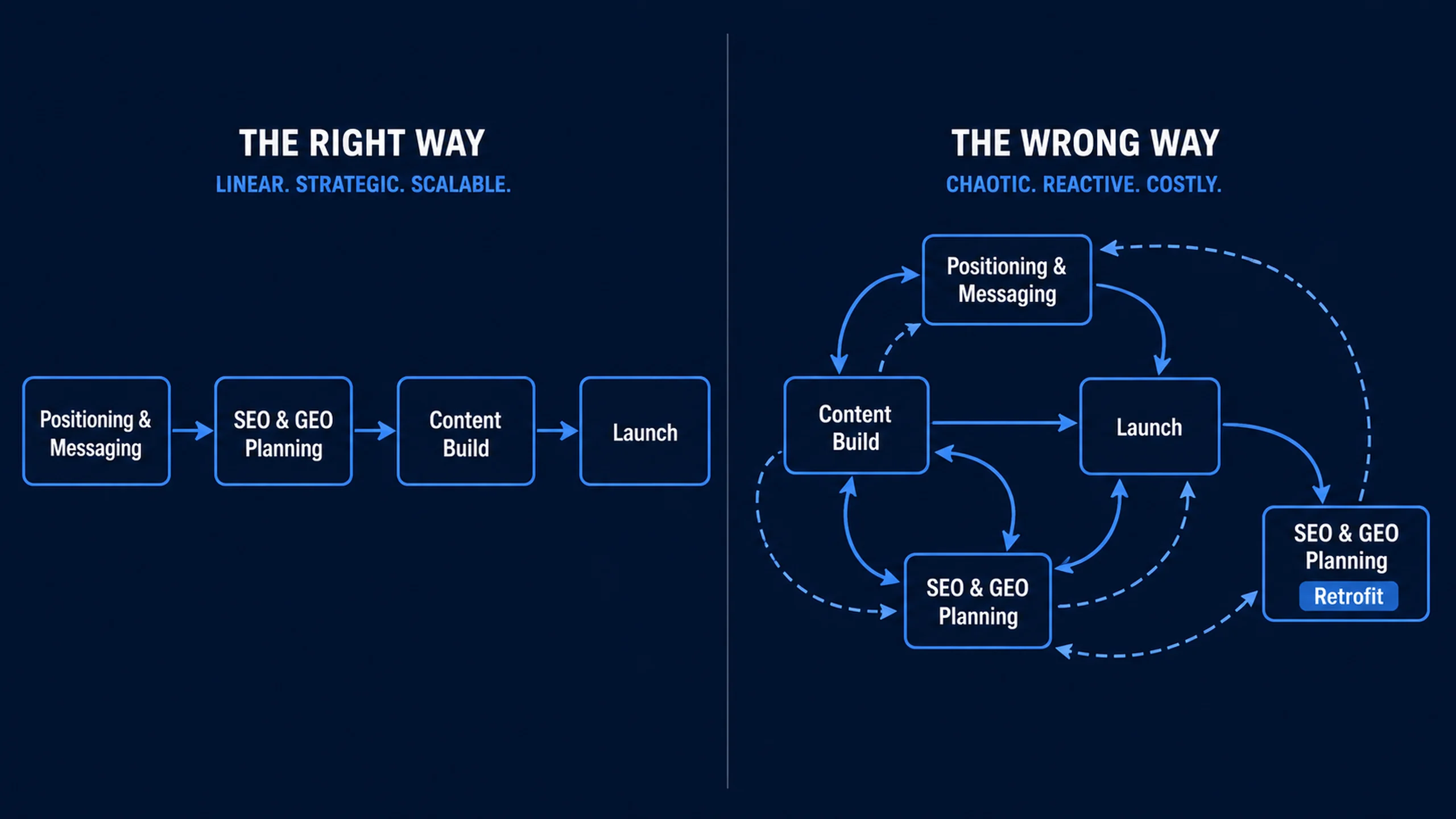
The wrong order is rarely about which tactical step to do first. It is conceptual. Companies treat SEO and GEO as the layer that gets added after the content is built, instead of the framework that shapes how content is built. That sequencing decision is where most of the cost gets created.
I have been running GEO programmes across three sites for the last six months: Akamas, an established enterprise performance optimization platform; bluestates.ch, my own consulting site, newer and lower authority; and a third project at the earliest stage. The three sites occupy different points on the build-versus-retrofit spectrum. The contrast has made one thing clear: the order you choose makes the difference between a parallel content and GEO build that ships together, or a separate optimisation project that runs for months after launch.
The afterthought problem
The wrong order is not primarily a question of which generative engine optimization tactic to do first. The wrong order is conceptual: treating SEO and GEO as the layer that gets added after the content is built.
This is the most common version of the mistake. A company does positioning and messaging work, sometimes well, often expensively. The output gets briefed to a content team to translate into website copy. The content team writes, leadership reviews, copy is debated word by word, weeks pass, the site eventually launches. Then SEO and GEO arrive as the next agenda item, and the team discovers that content optimised for “what we want to say” is not optimised for “what the audience searches for, and what AI engines cite.” The two are not the same thing.
The rewrite begins, and now the content is anchored. People are attached to words they spent weeks defending. Resistance to changes is high. Iterations are slow. The SEO and GEO project stretches across months. Highest-priority pages often stay unoptimised the longest because they are the ones with the most stakeholders attached.
I have lived the wrong version of this myself. At the end of 2025 I led a revamped positioning exercise, then company and product messaging platform that led to content refresh on the primary pages of the website. Finally proposing SEO and GEO optimization as the next phase. The sequential thinking felt natural, especially because my marketing experience was anchored in the SEO playbook from Sysdig in 2015 and Instana in 2016 to 2018, before I moved into product management. I knew the old discipline, but I had not internalized how much GEO had changed the work. Treating optimization as a phase that came after content felt like the obvious order.
It was the wrong one. Once content is built and reviewed by multiple stakeholders, every word becomes a defended position. Updating that content for SEO and GEO afterwards is twice the work: once to do it, once to negotiate it through people anchored to the original phrasing. The work eventually moved forward on the long tail of blog content, where the iteration cycles were shorter and the anchoring was looser. The primary pages are slower because the cost of rework is higher there.
Refreshing my SEO and GEO knowledge in that period changed the way I now approach content from the start. Across the projects I am running today, the sequence is reversed: positioning and messaging first, then SEO and GEO planning, then content build against that framework. The same total work happens, but it happens once instead of twice. Decisions are faster because the rationale for word choice is shared. “We use this phrase because it has demand we can rank for, and it surfaces in AI citations for our category” is a better tiebreaker than “I prefer this word.”
What the research says about GEO timing
This is not just a practitioner observation. The academic and industry data confirm both the direction and the compound cost of getting the order wrong.
The foundational research on GEO came from Princeton University’s 2024 study by Aggarwal, Murahari, and colleagues, presented at ACM SIGKDD. It ran controlled experiments across 10,000 queries and demonstrated that structured GEO techniques can boost AI visibility by up to 40%. That headline number gets quoted often. The more interesting finding is buried underneath: lower-ranked pages (around position 5) gained 115% visibility from GEO optimisation, while pages already ranking at position 1 saw almost no additional lift. In other words, GEO benefits concentrate on content that was designed to be citable, not on content that already had SEO strength retrofitted onto it.
That result matters for the order-of-operations argument. Building GEO-native content from the start captures the largest compound effect. Adding GEO on top of already-ranked pages produces smaller gains, because the pages are already competing on the traditional SEO layer.
The industry data reinforces the same pattern. Google’s own May 2026 guidance confirmed that AI Overviews and AI Mode use retrieval-augmented generation and query fan-out, and are rooted in the same core ranking systems as regular Search. GEO is not a separate discipline bolted onto SEO. It is the extension of SEO into a mechanism where content structure, entity clarity, and authority signals determine whether a page gets cited by AI.
Recent industry analysis puts the compound effect in sharper terms. The Digital Bloom’s 2026 GEO report describes GEO authority as behaving “a lot like domain authority did in the early years of SEO. It builds over time. It gets harder for competitors to match. Early movers can create structural advantages that persist.” Enrich Labs’ 2026 guide puts it even more directly: “GEO is where SEO was in 2010 — a recognized opportunity with a rapidly closing first-mover window. Waiting is a competitive disadvantage that compounds over time.”
The consensus across the research is the same as the operator experience: the cost of doing GEO late grows faster than the cost of doing it on time.
Why doing GEO planning before content build changes everything
When generative engine optimization arrives after the content is built, it is a critique. When it arrives before, it is a design constraint.
The difference is operational. Treated as a critique, every GEO recommendation has to win a separate argument with whoever wrote and approved the existing copy. Treated as a design constraint, GEO becomes a shared criterion that anchors the writing. The brief includes the focus keyphrase, the synonyms, the structural rules, the schema requirements. Writers and reviewers debate within that frame instead of around it.
That shift produces three concrete effects. Decisions move faster because opinion debates have an external reference. Content launches already optimised, so there is no separate retrofit project. Stakeholders accept GEO-driven phrasing more readily because they were not anchored to a previous version. The cost saved is not just in the optimisation work itself. It is in the negotiation cost that the optimisation work generates when it arrives late.
The operational order inside the build
Once the conceptual order is right (positioning, then SEO and GEO planning, then content build), there is a second order question inside the content build itself. The seven-step sequence I follow across all three sites is below. The depth of each step varies by site condition. The order does not.
1. Index. Verify the site is crawlable by all relevant agents: Google, Bing, GPTBot, ClaudeBot, Perplexity, Google-Extended. Bing Webmaster Tools should be set up with sitemap submission, because Bing indexation is the prerequisite for ChatGPT visibility. Without this step, every subsequent action produces no measurable result.
2. Structure. Implement schema (Article, TechArticle, FAQPage, Person) on every page that should be citable. Set up /llms.txt at the root with a structured map of the content. Ensure URL hierarchy is logical and stable. This step does not move rankings by itself. It makes everything that comes later legible to AI systems.
3. Authority. Add author bylines with credentials on every piece of long-form content. Surface E-E-A-T signals: who wrote this, what is their experience, what proof anchors their argument. This is the single highest-leverage move for boutique firms and individual experts, because AI engines weight named, credentialed sources heavily.
4. Content. Write or rewrite with Query Fan-Out in mind. Lead with a direct-answer paragraph. Use atomic, self-contained claims that can be cited without surrounding context. Cover the main question and the predictable sub-questions. Add Q&A blocks at the end. Use synonyms throughout. Each section should be readable as a standalone module. This is the largest investment of time, and where retrofit costs explode if the conceptual order was wrong.
5. Distribute. Publish where AI training and citation pipelines see the content. Your own site, but also LinkedIn, GitHub for technical content, Reddit where appropriate, and platforms with high crawl frequency. The same argument should be discoverable in multiple places that AI systems weight.
6. Measure. Track signals that do not depend on click attribution alone. Google Search Console for AI Overview impressions, Semrush for AI Overview detection on tracked keywords, and a dedicated tool like or Otterly for brand mentions in LLM responses. None of these is complete. Together they triangulate.
7. Iterate. Pages that perform should be expanded. Pages that do not should be analysed for what signal is missing. The compound effect builds over months.
Each step compounds the next. Skip step 1 and steps 2 through 7 produce nothing because the content is not visible. Skip step 2 and the AI engines find the content but cannot parse it. Skip step 3 and the content has no anchor for E-E-A-T weighting. Skip step 4 and the structure is empty. Doing step 4 first, before steps 1 to 3, is what wastes most agency budgets.
How this looks on three different sites
The three sites I am running generative engine optimization on are at different starting conditions. The contrast confirms why the conceptual order matters more than the inventory of tactics.
Akamas is the most established: an enterprise performance optimization platform with significant existing content, established domain authority, and an audience that researches highly technical purchases through both Google and AI engines. The retrofit work has been substantial. Pages that ranked well in 2024 needed restructuring for direct-answer paragraphs and Query Fan-Out depth. Author bylines and credentials had to be added systematically. The technical foundation was strong; the content layer required near-complete rewrites for the highest-priority pages.
Bluestates.ch is newer, smaller, lower authority. The opportunity here is different: less retrofit, more design from the start. Every new blog post is structured for GEO before publishing: author, schema, direct-answer paragraph, FAQ block, Query Fan-Out coverage. The technical foundation took longer than expected to set up because is a smaller project with less inherited structure, but with a CMS in place. Once improved, each new page enters the world already optimized. The cost per optimized page is a fraction of the Akamas retrofit cost.
The third project is the earliest. Different vertical, different audience, total-blank slate. Here the entire architecture, content strategy, and technical foundation are being built with GEO as a design constraint rather than a layer added later. The investment is concentrated in setup, the architecture chosen for speed and flexibility, but every page produced from this point forward inherits the foundation. This is what designing for AI visibility from the start actually looks like.
Across all three, the order of operational activities is the same. What differs is how much existing work has to be undone before work can be applied cleanly. The lesson from running them in parallel is that the conceptual order, the decision about when GEO planning enters the process, determines everything downstream.
The PLG connection
There is a pattern worth flagging. The companies that build strong product-led growth motions obtain a stronger generative engine optimization. The reason is not coincidence.
PLG companies build clean public documentation because their docs are key for both product evaluation and onboarding. They built structured content because their users needed to self-serve. They built community presence because community was a growth channel. They built authority signals because authority drove trust without a salesperson in the room. These are the same assets that AI engines now feed from, thus reward.
Companies that built sales-led GTM have a tendency to keep their best content behind logins, behind sales calls, behind gated forms. Those companies are invisible to AI engines, and the work to make them visible is essentially the work of becoming a PLG company on the content layer. That is more than a content project. It is an organizational shift.
I will write more about this connection next week. For now, the implication is concrete: if you do PLG well, you have a head start on GEO that compounds. If you do not, the retrofit is heavier than it looks.
The cost asymmetry, named
The reason most companies get the conceptual order wrong is that the cost is hidden. A site builds, launches, generates traffic. SEO is a separate budget line, contracted out, attached to existing pages. GEO arrives as a new agenda item: “we need to be visible in AI.” Same vendor, same model, retrofit by default.
The honest accounting is this. Integrating generative engine optimization into the content build from the start adds roughly 15 to 25% to content production cost. Retrofitting an existing site for AI visibility runs two to three times that cost, depending on the depth of the retrofit. Industry research on SEO migrations gives a reasonable benchmark for what can go wrong when retrofits are mishandled: organic traffic drops of 30 to 60% are not unusual.
The companies that get this right treat GEO as an architectural decision, not a marketing tactic. They make it part of how content is briefed, written, and approved. They build the technical foundation once and add new content into it cleanly. The companies that get this wrong treat each blog post as a one-off and bolt on optimisation after the fact.
The order of operations exists because the architecture comes first. You do not paint a house before you build it.
FAQs
What is generative engine optimization?
Generative engine optimization is the practice of making content discoverable and citable by AI search systems including ChatGPT, Gemini, Perplexity, and Google’s AI Overviews. It extends traditional SEO with tactics that address how AI systems retrieve, parse, and cite sources. Core practices include direct-answer paragraphs, atomic claims, structured schema markup, author byline credibility (E-E-A-T), and Query Fan-Out content coverage. GGenerative engine optimization is not a replacement for SEO. Strong traditional SEO rank remains a prerequisite for AI visibility, and the Princeton GEO study demonstrated that structured GEO techniques can boost visibility by up to 40% in AI-generated responses.
Why is the order of operations for GEO important?
The order matters at two levels. Conceptually, treating GEO as a phase that comes after content is built leads to twice the work: once to write content driven by opinion, once to rewrite it once SEO and GEO criteria arrive. Operationally, within the build itself, each GEO step compounds the next: indexation is the prerequisite for everything else, structure makes content legible, authority signals anchor E-E-A-T weighting, and content optimisation amplifies all of the above. Skipping or reordering steps wastes budget because later steps depend on earlier ones being in place.
What is the cost difference between designing for GEO and retrofitting?
Retrofitting an existing site for generative engine optimization typically runs two to three times the cost of designing for AI visibility from the start. The reason is that retrofits require near-complete content rewrites on the highest-priority pages, while preserving existing SEO equity through careful migration. Designing from the start adds roughly 15 to 25% to content production cost but produces optimised pages from launch without needing to be undone.
How long does generative engine optimization take to show results?
Most measurable effects of GEO work appear over three to nine months, depending on site authority and starting condition. Technical foundations (indexation, schema) take effect within weeks once propagated. Content optimisation effects compound as AI systems re-crawl and re-index. Authority signals compound slowest because they depend on accumulated citation and reference patterns. Sites with established SEO authority see GEO results faster than new sites, because traditional rank still feeds AI visibility.
What is Enrico Bruschini’s background in SEO and GEO?
Enrico Bruschini is the founder of Blu Estates, a boutique GTM and PLG consulting firm for enterprise SaaS. He is the former Director of Product-Led Growth at Instana, acquired by IBM, and a former product leader at Sysdig. His marketing background dates to the Sysdig and Instana years (2015 to 2018), and he has refreshed his SEO and GEO knowledge while running optimisation programmes across three sites with different starting conditions over the past six months.
Is Your Company Interested in Product-led Growth?
Explore whit us a future where humans thrive with innovative products