
The Product Strategy and Product-led Blog
ai, enterprise-sales
You're No Longer Selling to Humans First
Picture this. Your enterprise sales team has spent four months on a deal. They mapped the org, found the champion: a VP of Engineering who gets it, who has internal credibility. They built the relationship, ran the discovery, the demo, the POC. The champion
Enrico Bruschini | May 28, 2026
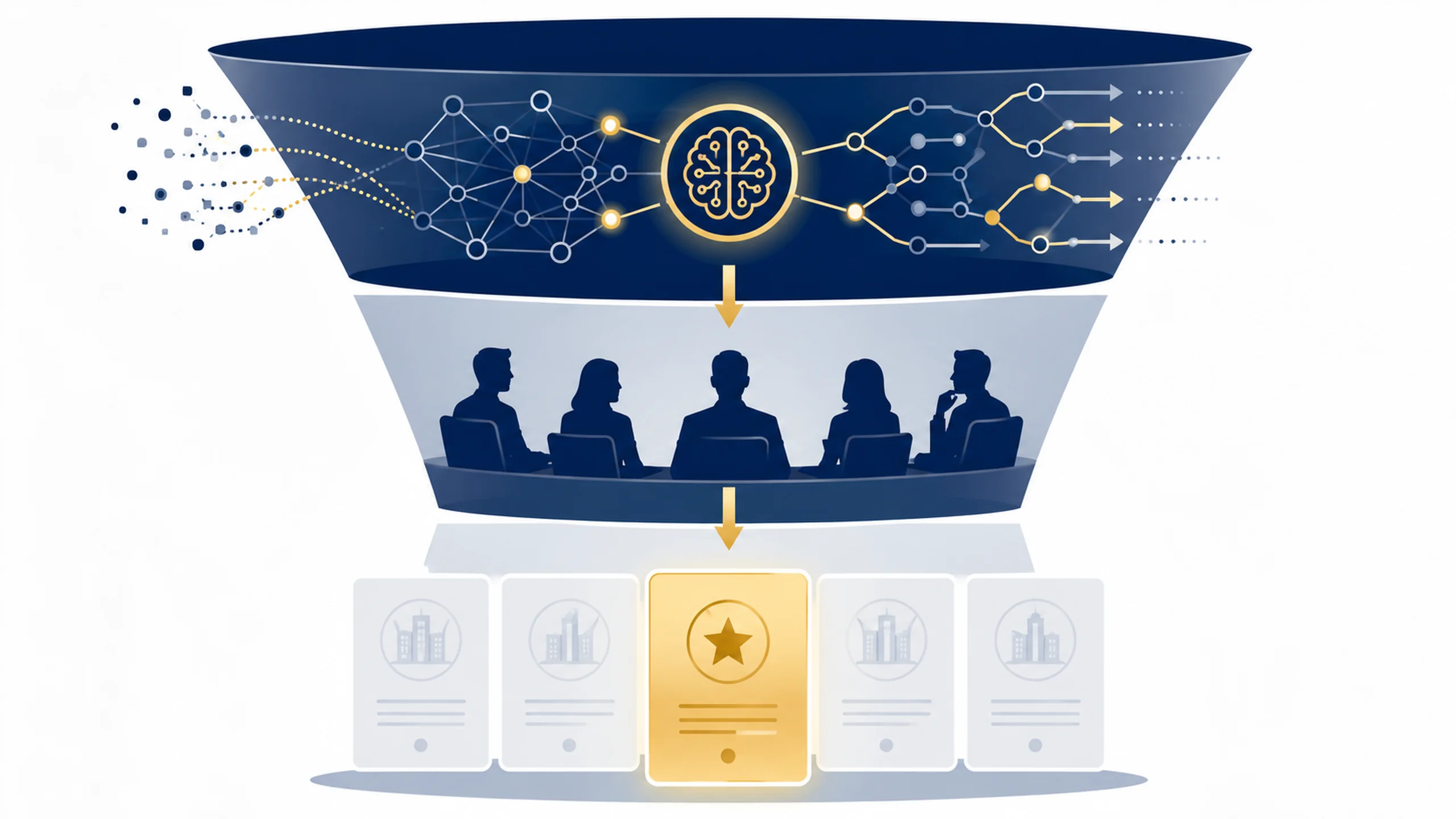
Picture this.
Your enterprise sales team has spent four months on a deal. They mapped the org, found the champion: a VP of Engineering who gets it, who has internal credibility. They built the relationship, ran the discovery, the demo, the POC. The champion loves what he sees.
Now he needs to sell it internally: to his peers, his manager, and the executive buyer who controls the budget but has no time to evaluate a technical product in depth.
So he does what everyone does in 2026: he opens ChatGPT. He asks it to summarize your product’s positioning, help him write an internal memo making the case for the investment, and compare your solution to the two alternatives he’s been considering.
What the AI says next is completely outside your control.
And that is exactly the problem.
AI in B2B sales has changed in a way most GTM teams haven’t caught up with yet. AI engines now run inside your buying committee before your sales team gets the first call. Your champion uses ChatGPT to draft internal memos, Gemini to compare vendors, Copilot to brief managers who never read your website. Generative engine optimization (GEO) is not a marketing tactic. It is how you ensure AI describes your product accurately to every stakeholder you cannot reach.
The part of enterprise sales nobody is talking about
Enterprise sales has always been about relationships. It still is. Your champion is real, your relationship with him is real, and no AI is replacing that.
But your champion now uses AI the same way he uses Google Docs: as a daily tool to get things done faster. He uses it to draft internal communications. To build business cases. To prepare for conversations with stakeholders who know nothing about the technical domain and need to be convinced quickly.
Forrester’s January 2026 Buyers’ Journey Survey of 18,000 global business buyers found that B2B buyers now use AI tools to research product information (54%), compare vendors against each other (55%), and, crucially, build internal business cases before engaging any vendor (47%). Nearly half of buyers are using AI not just to find you, but to sell you inside their own organization.
B2B buyers are now researching vendors inside Microsoft Word, Google Docs, Gmail, and Outlook: asking Copilot to draft vendor comparisons, prompting Gemini to summarize their options. Even a simple Gmail search now surfaces an AI-generated summary before any results. The AI is embedded in every tool your champion uses every day.
This is not a marketing problem. It is a shift in AI in B2B sales that lives in a part of the deal you have no direct visibility into.
How the traditional enterprise sales motion works, and where it breaks
Sales methodology has given us useful frameworks for decades. Miller Heiman. MEDDIC. Challenger. They all agree on one thing: in a complex enterprise deal, you’re not selling to one person. You’re selling to a buying committee.
Forrester’s 2025 survey found the average B2B purchase now involves 13 internal stakeholders and 9 external participants. Your champion has to build consensus across most of them. Each of those stakeholders is increasingly using AI in their own B2B research before the budget conversation.
The classic map looks something like this: the champion does the technical evaluation and becomes your internal advocate. The economic buyer controls the budget but relies on the champion’s recommendation. Decision makers and influencers, including peers, managers, sometimes legal and sometimes security, each validate a piece of the picture. The CFO signs off on financial sustainability and contract terms, not on whether your observability platform or your performance optimization engine will actually work in production.
Your sales team can influence the champion directly. You can arm him with materials, talk tracks, ROI calculators. But you cannot be in the room when he talks to his VP. You cannot control the summary Gemini generates when his manager does a quick check on your product. You cannot see the AI-written internal email that frames the decision to the executive buyer.
The shortlist forms before your first call
The 6sense 2025 Buyer Experience Report, which surveyed nearly 4,000 B2B buyers, found that 95% of the time, the winning vendor was on the buyer’s shortlist before formal evaluation began. The shortlist doesn’t form in your demo. It forms in AI-assisted research sessions that happen before your sales team knows there’s a deal to win. It gets reinforced every time a stakeholder turns to AI to validate what the champion is telling them.
If AI describes your product incorrectly, incompletely, or not at all, you are losing ground across a twelve-person buying committee without a single person in your company knowing it’s happening.
AI in B2B sales is not a traffic problem. It’s a deal erosion problem.
GEO — generative engine optimization — is typically discussed as a discovery tool: a way to show up when AI in B2B sales research happens before your competitors do. And yes, it does that. G2’s March 2026 survey of 1,076 B2B software buyers found that 69% chose a different vendor than they initially planned based on AI chatbot guidance, and one in three bought from a vendor they had never heard of before.
But the more urgent problem for an enterprise sales team isn’t discovery. It’s deal erosion.
You found the champion. You’re in the deal. And now AI is running silent background checks on your product on behalf of everyone the champion needs to convince — the peer who asks Perplexity whether your product is enterprise-ready, the manager who has Gemini draft a comparison before the budget conversation, the executive buyer who asks ChatGPT what analysts say about your category.
The silent background check
Buyers often approach sales conversations with a preferred option already in mind — and that preference was shaped before any vendor interaction (Sopro, 2025 synthesis of buyer behavior data).
If you haven’t given AI engines accurate, structured, authoritative information about your product, they will fill the gap with whatever they can find — or tell your stakeholders they don’t have enough information to make a recommendation. In a high-stakes enterprise deal where the default outcome is “do nothing,” that silence is your competitor.
GEO is not the new SEO. GEO is the new sales enablement layer — the one that operates inside your champion’s buying committee, in the tools they use every day, in the conversations you will never be invited to.
What this means in practice
You do not need to abandon relationship selling. You need to extend it.
The work you do with your champion, the positioning, the differentiation, the proof points, now also needs to exist in a form that AI engines can retrieve, understand, and accurately summarize. The goal is not search rankings: it is the twelve stakeholders your champion needs to convince, all of whom will, at some point, ask an AI about your product.
On the average B2B deal’s first day, the buyer has already built a shortlist of about five vendors. 95% of the time, the winner is already on it (6sense, 2025). Your job is to be on that list. But your second job, the one that nobody has been talking about, is to make sure AI describes you accurately to everyone who checks after you’re already there.
Five things to do this quarter
Concretely, that means five things.
1. Check that AI crawlers can access your site. GPTBot, PerplexityBot, ClaudeBot, and Google-Extended all need to be explicitly allowed in your robots.txt. Many companies block them unintentionally. If bots cannot read your content, AI engines fall back on training data, which may be months or years out of date.
2. Structure your key pages for atomic citability. AI engines extract individual sentences. Every claim about your product, what it does, who it’s for, how it compares, must read correctly in isolation. No orphan pronouns. No vague category language. “Akamas uses AI to continuously optimize application performance in production environments” is citable. “It helps companies improve efficiency” is not.
And on the technical side
3. Add schema markup to every page that makes a claim. Schema tells AI engines who wrote something and why they’re qualified to say it. It is one of the core elements of any GEO strategy for SaaS. Article schema with a named author, FAQPage schema on Q&A content, Organization schema with links to your LinkedIn and analyst profiles. These are the signals that make your content structurally retrievable rather than just crawlable.
4. Build a /llms.txt file. The emerging standard at llmstxt.org gives LLM crawlers a structured, canonical summary of who you are, what you do, and what your key URLs are. It is the AI-era sitemap. It takes hours to create and most companies don’t have one.
5. Publish content that answers the questions your champion’s stakeholders will actually ask. Not blog posts for search traffic. Content structured around the real objections that come up when your champion walks into an internal presentation: Is this enterprise-ready? How does it compare to [competitor]? What does implementation actually look like? Those are the prompts that get asked. Write the answers that deserve to be cited.
The stakes will only increase
AI’s role in enterprise sales is not at its peak. It is at its beginning.
Today, AI in B2B sales is the research layer your stakeholders use to prepare for human conversations. The next phase, already visible in early deployments, is AI agents that participate in vendor evaluation directly: querying APIs, running automated RFP responses, synthesizing analyst reports without any human prompting.
If your product is not legible to AI engines today, you will not be on the shortlist when AI agents start making the initial cuts.
The companies that invest in GEO now are not chasing a marketing trend. They are future-proofing the top of their sales funnel and protecting the deals their sales teams are fighting for right now.
FAQs
What has changed about AI in B2B sales, and why does it matter now?
AI in B2B sales has shifted the research process inside the buying committee. Buyers now use AI tools — ChatGPT, Perplexity, Gemini, Google AI Overviews — not just to find vendors, but to build internal business cases, draft stakeholder communications, and compare options before a sales team gets the first call. Forrester’s January 2026 survey found 47% of buyers use AI to build internal business cases before engaging any vendor directly. If AI describes your product inaccurately or not at all, your champion is selling uphill inside their own organization without knowing it.
What is GEO, and how is it different from SEO?
Generative engine optimization (GEO) is the practice of structuring your content so that large language models can retrieve, understand, and accurately summarize it when buyers ask relevant questions. Traditional SEO optimizes for keyword rankings in Google’s results pages. GEO optimizes for AI citation — being the source an AI engine references when it generates an answer. The two require different signals: SEO rewards backlinks and keyword density; GEO rewards authoritative authorship, atomic claim structure, schema markup, and factual density. Only 8 to 12% overlap exists between pages that rank well in traditional search and pages that get cited by AI engines (Semrush Brand Visibility Framework, April 2026).
Does GEO replace relationship selling in enterprise deals?
No. Enterprise deals still close through human relationships, and that won’t change for complex, high-value solutions. What GEO addresses is a different layer: the AI-assisted research that happens inside your champion’s buying committee, between the people your sales team never directly reaches. Your champion uses AI to build internal business cases, draft stakeholder communications, and prepare for budget conversations. If AI describes your product inaccurately or not at all, your champion is selling uphill without knowing it. GEO doesn’t replace the relationship. GEO supports it at every point in the deal where your sales team isn’t in the room. It is also why product-led sales teams need it most — your product’s usage data only creates pipeline if AI also endorses your product when the economic buyer checks.
How do I know if AI is describing my product accurately right now?
Open ChatGPT, Perplexity, and Google AI Mode. Ask: “What is [your product]?” “How does [your product] compare to [main competitor]?” “Is [your product] enterprise-ready?” Read the answers as if you were a stakeholder with no prior knowledge of your solution. What you find is exactly what your champion’s peers are finding when they ask the same questions. Most companies are surprised — either by inaccuracies, by outdated positioning, or by silence.
Is Your Company Interested in Product-led Growth?
Explore whit us a future where humans thrive with innovative products