
The Product Strategy and Product-led Blog
geo
SEO vs AEO vs GEO: Let the Gurus Argue, Here's What Works
SEO vs AEO vs GEO: the acronyms fight for airtime, but six operator moves work across all of them. What the industry won't tell you.
Enrico Bruschini | July 13, 2026
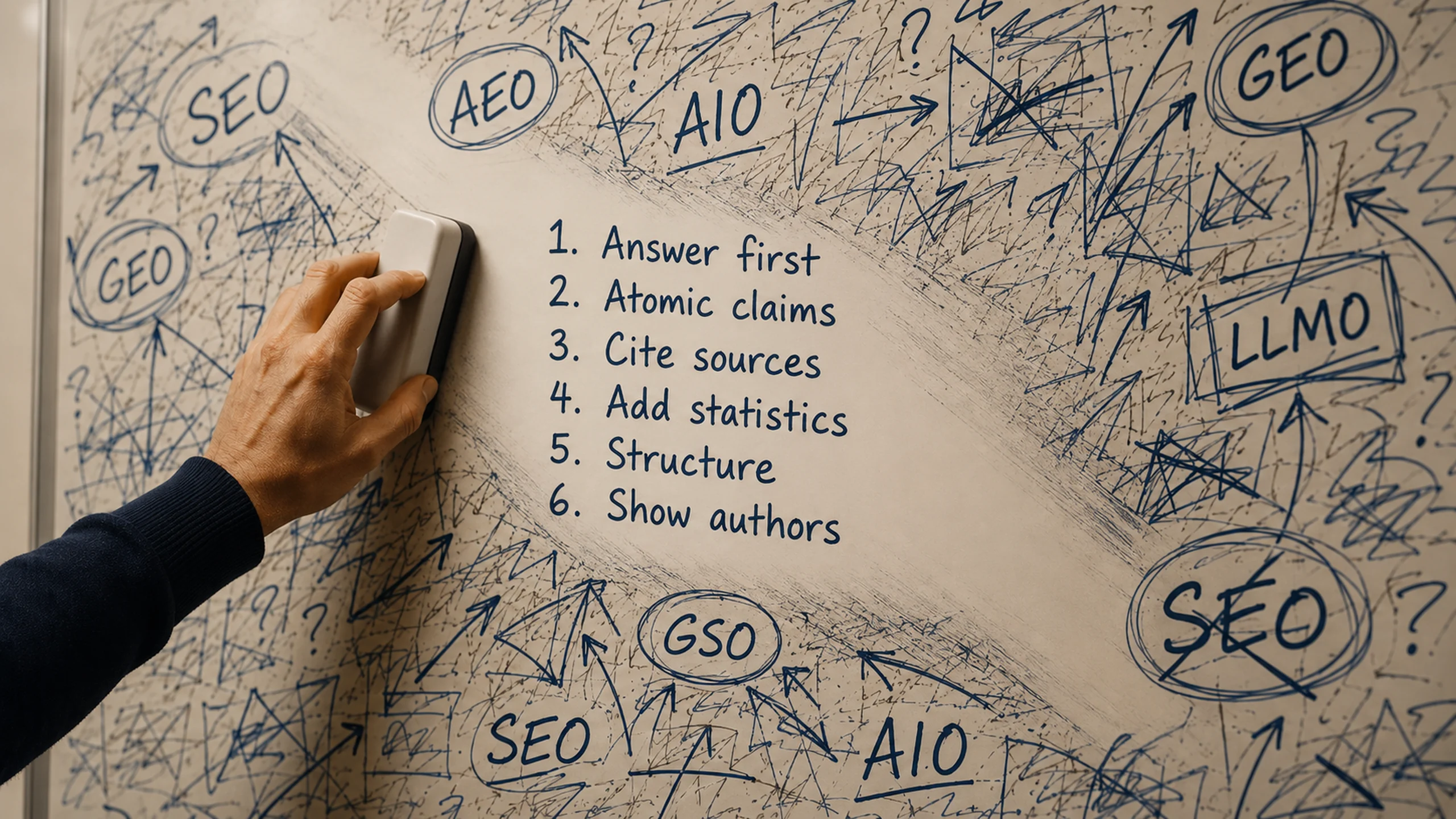
SEO vs AEO vs GEO: three disciplines that measure different things, one industry that cannot agree on what to call them. Six operator moves work across all of them, whichever acronym wins.
The rest of this post: what each label actually means, where they overlap, why the six moves matter more than the debate about the labels, and why doing them all will still hit a ceiling.
The alphabet soup
The search optimisation industry has produced four acronyms in eighteen months, with more in the pipeline. SEO you already know. AEO stands for Answer Engine Optimization. GEO stands for Generative Engine Optimization. AIO is Google’s AI Overviews. There is also LLMO, GSO, CAIO, and a few others being pushed by vendors who would like you to buy a package.
Nobody agrees on the terms. A Search Engine Land analysis of a year of LinkedIn posts found fewer than one third of SEO influencers maintained consistent terminology, and only 59% of them even reference GEO. Andreessen Horowitz picked GEO in their May 2025 thesis. Profound wrote a blog post arguing GEO is a bad name and picked AEO instead. Muck Rack uses GEO. Terakeet uses AIO. Digiday’s October 2025 explainer opened by conceding there is no common taxonomy.
Nate Elliott, EMARKETER’s principal analyst, put it plainly in April 2026: “GEO as a concept didn’t really exist until about a year ago.” Anyone who claims to have figured it out, he added, is probably either overconfident or selling something.
That is the setting for this post.
What each acronym is about
The one-sentence versions.
SEO optimises for rank position on a search engine’s results page. The output is a ranked list of blue links. Success metric: rank, clicks, impressions.
AEO optimises to be extracted as a direct answer inside an answer surface. Featured snippets, voice assistants, Bing Copilot, Perplexity’s answer box. Success metric: snippet ownership.
GEO optimises to be cited or referenced by generative AI as a source in a synthesised answer. ChatGPT, Perplexity, Gemini, Claude. Success metric: brand mention frequency and citation prominence.
AIO is Google’s specific AI Overview surface. It is not a fourth discipline. It is the surface where the other three collide inside Google, cited or not.
Where they overlap, and where they don’t
Two facts do the load-bearing work.
First, the divergence is real and it is recent. The overlap between Google’s top ten organic results and AI citations has collapsed from around 75% in mid-2025 to between 17 and 38% in early 2026, according to combined BrightEdge and Demand Local analysis. Muck Rack’s May 2026 study of 25 million AI citations found that 40 to 60% of cited sources change month-to-month across Google AI Mode and ChatGPT. Ranking well on Google no longer means being cited by the AI answer above it. That is the empirical case for treating GEO as a separate discipline.
Second, and less discussed: the content tactics that produce visibility across all three surfaces share a common core. The Princeton, Georgia Tech, and IIT Delhi team (Aggarwal et al., KDD 2024) tested nine content strategies across 10,000 queries. Statistics addition, quotation addition, and cite-sources each lifted visibility on generative engines by 30 to 40%. Those same tactics also drive featured snippet extraction on Google and produce cleaner rank signals for classic SEO.
The mechanism is the same. Extractable, attributable, structured content is what every engine prefers, whether it is ranking a link or building a paragraph.
The common ground: six moves that work everywhere
Let the gurus debate the naming and fight for water to their mills. In the meantime, the basics you have to get right no matter what label wins are these six.
1. Answer the question in the first paragraph, in fewer than 30 words. SEO rewards it (featured snippet extraction). AEO requires it. GEO citation selection prefers it. Every surface reads the opening the same way.
2. Write claims that stand alone under 17 words. Long, multi-clause sentences break during extraction. Every engine, whether snippet extractor or LLM, works better with atomic sentences it can lift verbatim.
3. Cite sources inline with named authorities. The Princeton paper measured a 115% relative visibility lift on Perplexity for sites that added inline citations. Google’s E-E-A-T framework rewards the same behaviour.
4. Include original statistics, one every 300 to 500 words. The Princeton study measured up to 41% visibility lift from statistics addition. Statistics are the currency of citation across every engine measured.
5. Structure with clear H2s, Q&A blocks, and FAQPage schema. Engines parse structure to decide what to quote. A well-labelled Q&A block is a citation magnet across Google featured snippets, Perplexity answer boxes, and ChatGPT synthesis.
6. Surface author credentials visibly. Byline, Person schema, About link. Muck Rack’s May 2026 data shows editorially attributed content is preferred by LLMs at rates far above anonymous content. Google says the same thing about E-E-A-T.
These are the six. You can refine at the margins for AEO, GEO, or AIO specifically. But these are the common ground that nobody in the industry actually debates. The debates are about the labels above them.
Why the six moves plateau
Do all six well and you will get more citations, more snippet ownership, and better rank on the queries your domain can compete for. You will also hit a ceiling, and it will be the same ceiling for the same reason across every discipline.
The reason: your own content only takes you so far.
Muck Rack’s May 2026 study, which analysed more than 25 million AI citations across ChatGPT, Claude, and Gemini, found that 84% of AI citations come from earned media, not from what brands publish about themselves. Paid content accounts for 0.3%. Press releases account for less than 2%. Journalism alone accounts for around 27%. A separate Ahrefs study of 75,000 brands found that brand web mentions correlate three times more strongly with AI Overview visibility than backlinks do.
The pattern is clear. AI engines learned credibility from a training corpus weighted toward editorially independent sources. The rules did not change for the live retrieval layer either.
Which means the six moves take you to the threshold. Crossing it requires other people talking about you, in outlets AI engines already trust. Two levers get you there. The direct one is PR and earned media: bylines, journalist relationships, being quoted as a source in category coverage. The indirect one is the one covered in our previous post on PLG and GEO: PLG builds the assets (public documentation, real free tiers, independent community discourse) that AI engines index as credibility signals, exactly the way editorial coverage does.
The operator conclusion, once you cut through the maze, is the same conclusion we landed on from the PLG angle: you cannot manufacture AI visibility from behind your own keyboard. You need other people talking about you.
Whatever the industry ends up calling this discipline, the shortcut through the acronym maze is the same. Get the six moves right. Get out of the building.
Frequently asked questions
What is the difference between SEO, AEO, GEO, and AIO?
SEO ranks pages. AEO extracts direct answers. GEO earns brand citations inside AI answers. AIO is Google’s AI Overview surface.
Which one should I focus on first?
Do the six common-ground moves. They serve every surface at once. Refine for specific engines only after the basics are in place.
Is GEO just SEO with a new name?
No. The overlap between Google’s top ten and AI citations has fallen from around 75% to between 17 and 38%. They are diverging.
Do I need to write different content for AEO, GEO, and AIO?
No. The content tactics share a common core. Distribution and earned media do the differentiating.
How do I actually measure GEO?
Track brand mentions across ChatGPT, Perplexity, Gemini, and Claude on a fixed weekly prompt set. Tools include Muck Rack Generative Pulse, Seer’s Generative AI Tracker, Ziptie, and Profound.
Is Your Company Interested in Product-led Growth?
Explore whit us a future where humans thrive with innovative products