
The Product Strategy and Product-led Blog
plg
Mastering The Emotions' Rollercoaster Is Key to a Succesful PLG Strategy
Product-Led Growth (PLG) is the most misunderstood strategy in tech today.
Enrico Bruschini | March 2, 2025
Product-Led Growth (PLG) is the most misunderstood strategy in tech today.
Often, it’s mistaken for introducing a trial to the product or operating under a freemium model. While these elements can be part of PLG, they’re far from defining this strategy. PLG isn’t about one-off tactics — it’s about fundamentally changing how you build and deliver value with your product.
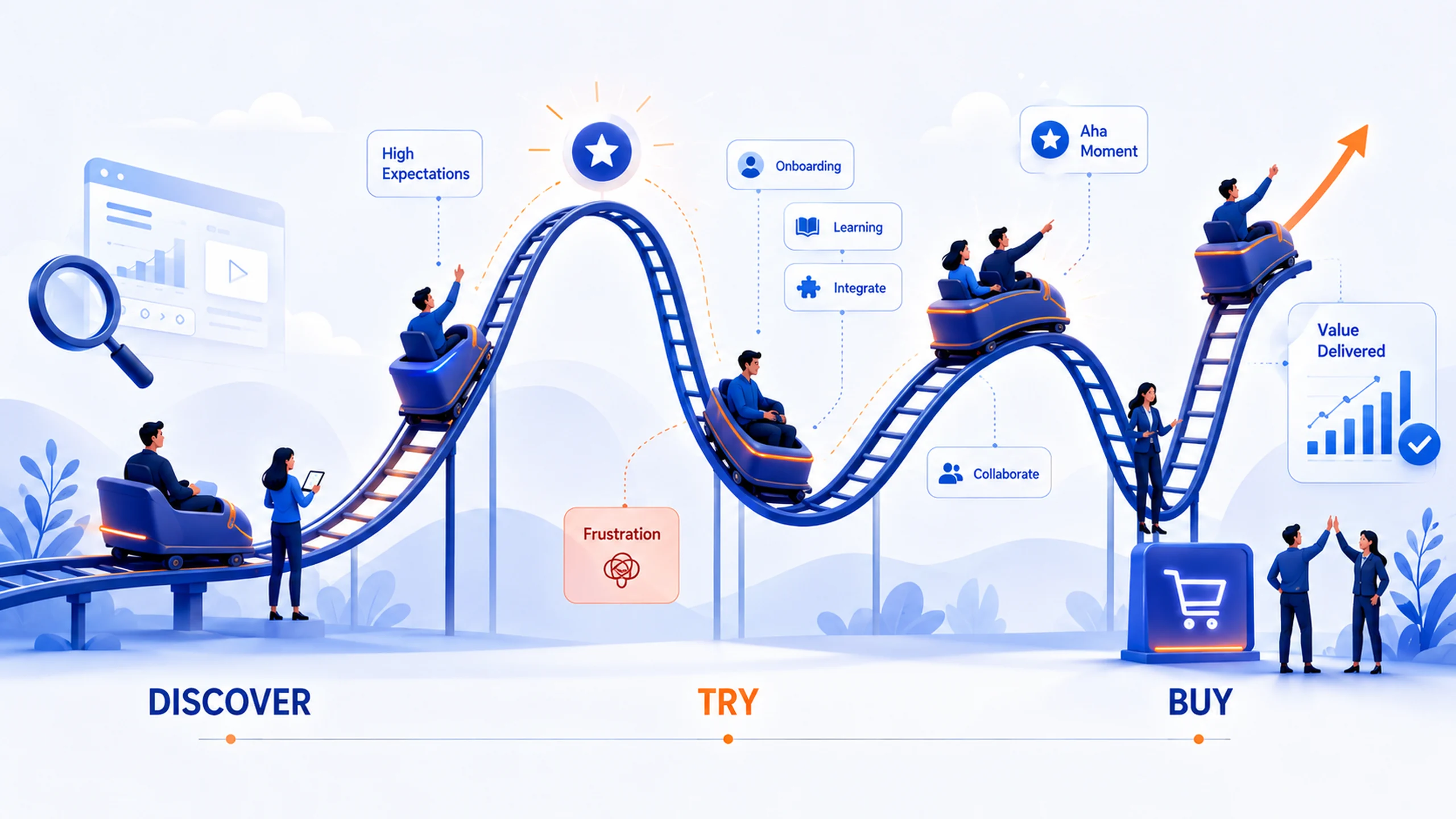
A PLG strategy is a go-to-market motion where the product itself drives user acquisition, activation, and expansion. Mastering it requires designing a user journey that deliberately manages the emotional highs and lows — excitement, frustration, and the “aha” moment — across three phases: Discover, Try, and Buy.
A successful PLG strategy demands a user-centric approach. It requires building a product that prompts users to complete a full cycle independently, realizing the product’s value on their own. It also demands anticipating the emotional rollercoaster users will inevitably experience. PLG companies grow revenue 2–3× faster than sales-led peers. (OpenView Partners, 2024 PLG Index.)
You don’t achieve this with hacks like trials and freemium. It goes much deeper and may require you to restructure your Product organization completely.
Let me tell you why.
The Rollercoaster of Excitement in PLG Strategy
When a user interacts with a new product for the first time, they feel a rollercoaster of emotions.
At first, there is excitement. The product might solve their problem or offer an innovative experience. But frustration inevitably creeps in when they face a learning curve, requirements, or a technical hurdle.
If this frustration is left unmanaged, users will abandon the journey.
This is where telemetry becomes invaluable. By tracking user behavior, you can anticipate moments of friction and proactively address them. These insights help you adjust the experience, balancing frustration with excitement to keep users engaged.
This emotional cycle is at the heart of PLG success.
As an example, Instana introduced a low-setup public demo that allowed users to experience the product with minimal effort. This built excitement right from the start. Later, in the trial phase, users had to integrate their own data — a more demanding task that brought some frustration. But the product had already established trust, so users were willing to push through.
A true PLG organization masters these ups and downs.
It becomes easier when you think of the user journey as made up of three phases: Discover, Try, and Buy.
Your PLG Strategy Should Manage User Emotions
Each phase of the user journey presents unique challenges and opportunities. To guide users effectively, focus on designing experiences that balance excitement and frustration across these stages.
1. Discover: Building Initial Excitement
Discovery is where PLG starts — and first impressions matter.
Your first goal is to invite users to explore the product with minimal commitment and low friction. This is also where your product-led growth strategy either creates momentum or kills it before the journey begins.
Take Instana as an example. The public demo allows users to interact with the product in a low-effort (no setup required), high-impact way — users get a clear sense of the capabilities immediately.
Instana’s example is a classic one. But there are ways to get creative here. Take Dash0 and its OTelBin — instead of using a subset of their product, they created a separate tool that helps configure OpenTelemetry. This worked well: it lets users complete a meaningful first step, building trust and excitement before engaging with Dash0’s core product.
In this phase, your product should spark curiosity and lay a strong foundation for users to move forward. Excitement is the driver that takes users from Discover to Try.
2. Try: Guiding Users to “Aha”
In the Try phase, users engage with your product more deeply.
The challenge is to balance the natural friction of learning and setup with enough excitement to keep them moving forward.
Returning to Instana’s example: the trial phase asks users to integrate their own data into the platform. This step requires effort, but the upside is clear — users realize the product’s value by seeing it in action in their real-world scenario.
When done right, this leads users to an “aha” moment.
To execute PLG well in this phase:
- Tailor the trial experience to solid user needs (Jobs To Be Done)
- Be deliberate about which activation steps are required
- Identify and eliminate unnecessary friction points during onboarding
- Ensure the value you deliver outweighs the effort you ask for
If users don’t reach their “aha” moment here, they’re unlikely to move to a purchase.
3. Buy: Keeping Momentum
In the final phase, convert users’ enthusiasm into commitment.
Your product must have delivered on its promise before the transition from Try to Buy. Users who have experienced value during the previous phases are far more likely to commit. But the buying process must not introduce new friction.
To ensure users follow through:
- Highlight the benefits they have just experienced and those they will gain post-purchase
- Keep pricing simple and transparent
- Make it easy for the power user to demonstrate value to the decision maker — the person who signs off should be invited to approve, not asked to re-evaluate the product from scratch
This makes buying the natural next step in the journey. The same principles apply when you add a Product-Led Sales motion on top: sellers work with the same product signals, not against them.
The Right PLG Strategy Requires Organizational Transformation
PLG demands a holistic perspective, but many product organizations are structured around features. Siloed teams work on isolated functionalities, often at the expense of the consistent user experiences PLG depends on.
To overcome this, teams must collaborate across traditional boundaries to create a unified user journey. A holistic view allows organizations to guide users effectively through the Discover, Try, and Buy phases.
For example, the path to “aha” often involves several features working together. Without cross-functional coordination, you risk frustrating users, undermining their excitement, and causing them to abandon before realizing the product’s value.
To succeed with PLG, you may need to transform your entire Product organization. A PLG structure focuses on delivering user outcomes rather than siloed feature releases. It requires:
- Aligning teams around user value and user experiences
- Centralizing insights to identify friction points and opportunities for improvement
- Breaking down silos to foster cross-functional collaboration
This transformation allows your organization to realize the full potential of Product-Led Growth — driving user satisfaction and revenue growth together.
Conclusion
PLG is about putting users at the center of your product strategy, empowering them to discover, try, and buy with minimal friction.
Success lies in finding the balance between excitement and frustration — designing experiences that deliver value at every stage. But this demands a real transformation of your product organization, not a surface-level tactic change.
The companies leading in PLG have restructured their teams, broken down silos, and adopted a user-first mindset.
Want to assess where your organization stands? Start with three questions:
- Is your product delivering excitement at each phase of the user journey?
- Do your teams collaborate to create consistent experiences, or are silos blocking them?
- Are you prepared to rethink your product organization to realize PLG’s full potential?
FAQs
What is a PLG strategy?
A PLG strategy — or product-led growth strategy — is a go-to-market approach where the product is the primary driver of user acquisition, conversion, and expansion. Instead of relying on a sales team to generate demand, PLG companies let users experience product value first, then convert them to paid accounts based on that experience.
What are the three phases of a PLG strategy?
The three core phases are Discover, Try, and Buy. In Discover, users encounter the product with minimal friction and build initial excitement. Once in Try, they engage more deeply — ideally reaching an “aha” moment. In Buy, prior value experience converts into a purchase decision. Each phase requires deliberate design to balance excitement and frustration.
Why do PLG strategies fail?
Most PLG strategies fail because teams treat PLG as a tactic — adding a free trial or freemium tier to an existing sales-led motion — rather than redesigning the product organization around user outcomes. Without cross-functional alignment and deliberate emotion management, users reach friction points and disengage before the “aha” moment.
How does emotional journey design improve PLG conversion?
Tracking where users feel excitement versus frustration — using product telemetry — lets product teams intervene before users abandon the journey. Managing these emotional signals, rather than reacting to churn after the fact, is the operational core of a mature PLG strategy.
What organizational changes does PLG require?
PLG requires teams to organize around user outcomes rather than feature delivery. That means breaking down product silos, centralizing user journey insights, and creating cross-functional accountability for the Discover-Try-Buy experience. For most companies, this is a significant structural change, not just a process adjustment.
Is Your Company Interested in Product-led Growth?
Explore whit us a future where humans thrive with innovative products