
The Product Strategy and Product-led Blog
ai, plg
Does Product-Led Growth Still Matter in 2026?
Yes, more than ever. Product-led growth has not declined in relevance: it has become the minimum viable condition for any software product that wants to be discovered, evaluated, and recommended in an AI-first world. According to OpenView's 2024 Product
Enrico Bruschini | June 2, 2026
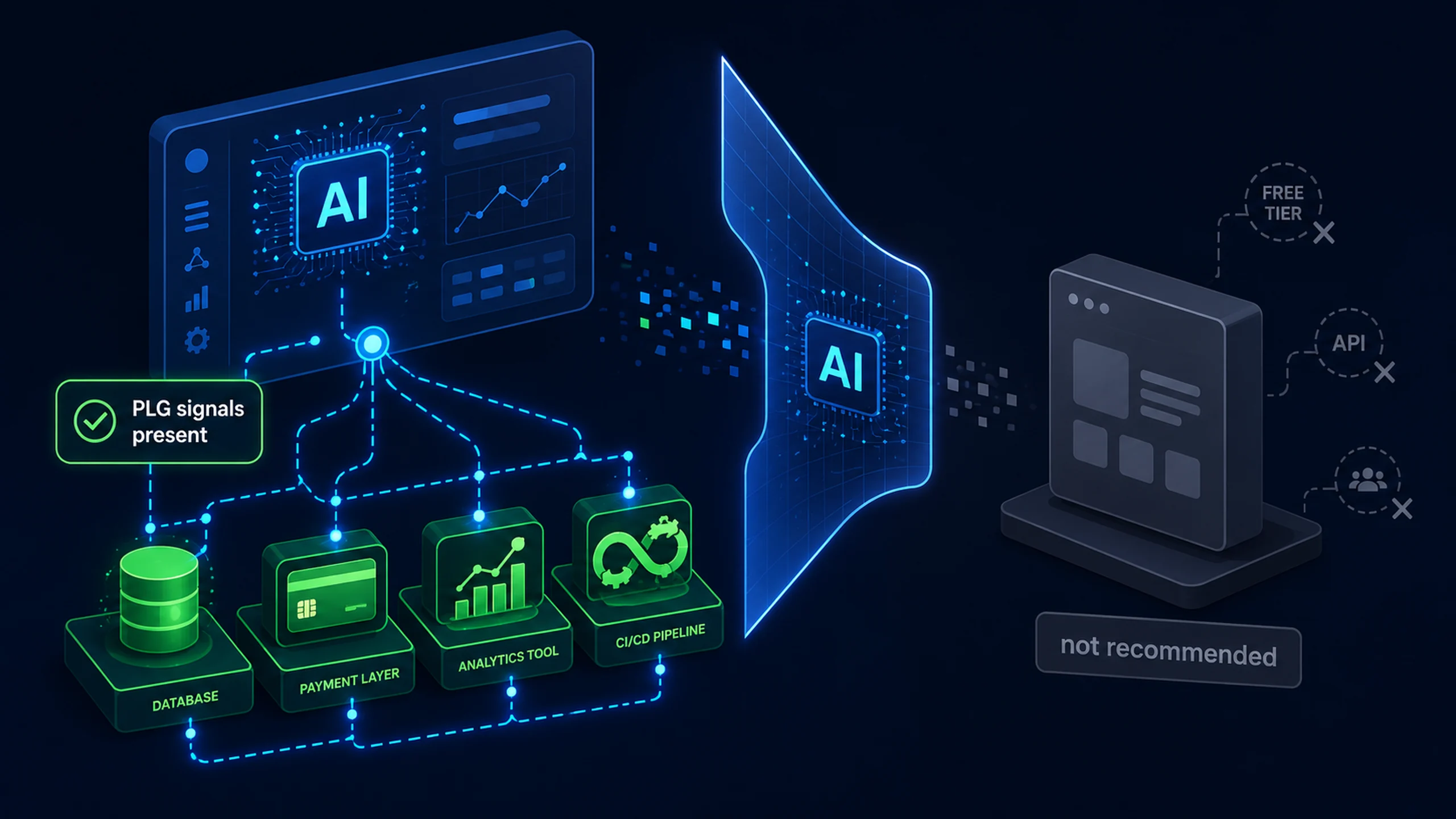
Yes, more than ever. Product-led growth has not declined in relevance: it has become the minimum viable condition for any software product that wants to be discovered, evaluated, and recommended in an AI-first world. According to OpenView’s 2024 Product Benchmarks report, over 58% of SaaS companies now run some form of PLG motion. PLG stopped being a differentiator because it became the baseline expectation, and in 2026, AI enforces that baseline — not buyers.
The clearest epiphany of this shift did not come from a client engagement. It came from a weekend project.
This weekend a stack got chosen without me
Last weekend I was vibe-coding. Building something from scratch, just me and Claude. Within the first hour of brainstorming, the entire stack was on the table. Not because I assembled it. Because the AI did.
The recommendation came up fully formed: Next.js on Vercel for the frontend and edge functions, Railway for the API server and background workers, Neon with Drizzle ORM as the primary database, Stripe and Stripe Identity for payments and user verification, Cloudflare R2 for object storage, Typesense for search, Resend for transactional email, PostHog for product analytics, GitHub Actions for the CI/CD pipeline, Dash0 for Observability, and Linear for product development management.
Many decisions. The AI recommended most of them.
I challenged them all, but ended up with only one substitution: for observability, Claude suggested Sentry, I chose Dash0 instead, because I know the team and trust their approach to the problem. But that one choice is precisely the point. When a human is directing an AI-assisted build, the human steers at the margins. The AI sets the defaults, and those defaults reflect which products it can discover, understand, and recommend with confidence.
Every product in that stack has a generous free tier. Each has structured documentation a language model can retrieve and reason about. All of them have a Claude connector, an MCP integration, or a well-documented API that AI tools already know how to use. The AI did not pick them because they were the most technically sophisticated options in their categories. It picked them because they were accessible: a developer can go from zero to running in an afternoon without talking to a sales team.
That is the PLG motion. In 2026, it is not a growth strategy. It is the price of entry.
What makes a product legible to AI
Legibility, in this context, means four things.
A real free tier. Not a “contact sales for a trial” form. An actual tier that a developer or evaluator can access without human intervention. This is what allows AI to say, with confidence, “you can start for free and upgrade when you need X.” Products that require a sales call to evaluate cannot be recommended to someone who is trying to move fast.
Structured, machine-readable documentation. Not marketing copy. Specific, factual descriptions of what the product does, how it works, what integrations exist, and how to get started in under an afternoon. This is what a language model retrieves when someone asks how a product works. If the documentation is vague, the AI’s answer will be vague. A vague answer in a competitive evaluation is a lost recommendation.
AI integrations treated as first-class features. A Claude connector, an MCP server, an OpenAI plugin, a Cursor integration, a GitHub Copilot extension. These are not nice-to-haves. They are the signal that a product belongs in the AI-native stack. When I looked at the products the AI recommended for my weekend project, every single one had either an existing AI integration or a sufficiently well-documented API that AI tools could reason about it without one. Dash0, the one product I added through my own judgment, has a clear API and structured documentation. That is why I was confident choosing it even without a specific AI connector: it has the underlying legibility even without the official integration layer.
A developer community that writes about it. The developer experience is good enough that people use it without being paid to, then document it, share it, and discuss it publicly. Those signals are how AI systems learn that a product has earned practitioner trust. A product with no community footprint is, from the AI’s perspective, unverifiable.
These are all PLG signals. Not marketing assets in the traditional sense. Structural product characteristics that determine whether an AI can confidently include your product in a recommendation to someone who has never heard of it.
The enterprise dimension
The implications extend well beyond solo developers building weekend projects.
As I wrote in the post on AI in B2B sales, enterprise buyers now use AI throughout the purchase process: to research vendors, build internal business cases, draft stakeholder communications, and compare options before a sales team gets the first call. Forrester’s January 2026 Buyers’ Journey Survey of 18,000 global business buyers found that 55% of B2B buyers use AI to compare vendors, and 47% use it to build internal business cases before engaging any vendor directly.
The shortlist forms before your first call
The shortlist forms before your sales team knows there is a deal. Which products make that list depends, in part, on which ones the AI can describe with confidence.
A product without a self-serve trial cannot be recommended to a buyer who wants to evaluate before committing. Without accessible documentation, it cannot be cited in a vendor comparison. No developer community, no free tier, and no AI integrations makes a product opaque from the AI’s perspective. It may be excellent, and exactly what the buyer needs. But if AI cannot find it, understand it, and explain it, it will not appear on the shortlist.
This is not a hypothetical risk. AI selects products this way right now, in real projects, with real people using it as a daily tool.
PLG as table stakes, not differentiator
The shift I am describing is not gradual. In the span of two or three years, PLG moved from “growth strategy for product companies” to “minimum requirement for AI discoverability.” The companies that understood this early are now the defaults in AI stack recommendations. The companies that treated PLG as optional are finding that AI simply does not know they exist, or cannot recommend them with confidence.
I now value the existence of a Claude Code connector more than features I would have considered critical three years ago. That is not a preference. It is a rational prioritization driven by how I actually build now. Every developer and every buyer who uses AI as a default tool is making the same calculation, consciously or not.
The PLG motion is no longer what differentiates the growth-stage SaaS company from its competitors. It is what qualifies a product for consideration in the first place.
FAQs
Does product-led growth still matter in 2026?
Yes, and more than it did when PLG was a novel strategy. Product-led growth has shifted from a competitive advantage to a baseline expectation. Over 58% of SaaS companies now operate some form of PLG motion (OpenView, 2024). More importantly, PLG signals — free tiers, self-serve access, structured documentation, AI integrations — are now the primary signals that AI systems use to decide which products to recommend. A product without a PLG motion is not just slower to grow. It is increasingly invisible to the AI tools that make the first product selection before any human evaluator gets involved.
Why did PLG hype decrease if it is more relevant than ever?
The hype decreased because PLG became the norm. The same thing happened with mobile-first design, with SaaS as a delivery model, with freemium pricing: each was intensely discussed until it became the default assumption, at which point the conversation moved on. The absence of discussion does not mean the absence of relevance. It means the debate is settled. Companies that have not yet built a PLG motion are not behind the trend. They are behind the baseline.
How does AI decide which software products to recommend?
AI systems recommend products they can reason about with confidence. That means products with accessible free tiers (so the AI can suggest trying before buying), structured documentation (so the AI can describe what the product does and how it works), existing AI integrations (so the product is already part of the AI-native ecosystem), and a practitioner community that writes about it publicly (so the AI has independent validation of the product’s quality). These are all product-led growth signals. The PLG motion is not just a user acquisition strategy. It is the set of characteristics that makes a product legible to AI recommendation systems.
What should a SaaS team do today to improve AI discoverability?
Three concrete actions. First, verify that AI crawlers — GPTBot, ClaudeBot, PerplexityBot — are allowed in your robots.txt. Many companies block them unintentionally. Second, audit your self-serve path: if a developer or evaluator cannot go from zero to a working evaluation in under an afternoon without talking to anyone, the PLG motion is not strong enough for AI to recommend it confidently. Third, prioritize at least one AI-native integration — a Claude connector, an MCP server, a Cursor plugin. These are the signals that tell AI systems your product belongs in the AI-native stack. The investment is small. The discoverability impact is significant.
Is Your Company Interested in Product-led Growth?
Explore whit us a future where humans thrive with innovative products